finiple Hong Kong Company Registration | Limited Company Setup



财税资讯和常见问题
Tax information and FAQs
整站搜索常见问题财税资讯
点击开始搜索
热门搜索
代理记账的流程工商服务注册公司知识产权代办
Tax information and FAQs
The Certificate of Incorporation (CI) and Business Registration Certificate (BR) are two core statutory documents for Hong Kong companies, differing entirely in purpose, issuing authority and validity period, with neither being dispensable.
Quick Overview of Core Differences

– Certificate of Incorporation (CI): Issued by the Companies Registry of Hong Kong, pursuant to the Companies Ordinance (Cap. 622).
– Business Registration Certificate (BR): Issued by the Inland Revenue Department (Business Registration Office) of Hong Kong, pursuant to the Business Registration Ordinance (Cap. 310).
– CI (Analogous to a Birth Certificate): Certifies that a company is legally incorporated and possesses independent legal personality, entitling it to sign contracts, hold assets and engage in litigation.
– BR (Combining Tax Registration & Business License): Certifies that a company has completed tax registration and is legally permitted to conduct business in Hong Kong, and is a prerequisite for tax filing, invoicing and bank account opening.
– CI: Permanently valid, unless the company is deregistered or wound up.
– BR: Valid for 1 or 3 years. Renewal upon expiration is mandatory; failure to do so constitutes an offense.
– CI: Company name, registration number, date of incorporation, and the Companies Registry’s official seal.
– BR: Company name, business registration number, nature of business, effective/expiry dates, and tax-related information.
– CI: Exclusive to limited companies.
– BR: Applicable to all business entities (including limited companies, sole proprietorships, partnerships, and branch offices).
Comparison of Key Application Scenarios
Mandatory Scenarios for CI
Bank account opening, contract signing, cross-border authentication, company amendment/deregistration, and legal proceedings.
Mandatory Scenarios for BR
Tax filing, invoice issuance, license application, annual review, and public display at business premises.
Application Sequence
Obtain the CI first, then apply for the BR with the CI as supporting document. For limited companies, both documents are generally processed simultaneously during registration.
One-Sentence Summary
– CI: Proves who you are (legal entity status).
– BR: Proves your eligibility to do business and obligation to pay taxes (business and tax compliance).

Key Concerns When Registering a Hong Kong Company – Follow-up Support & Risks Provide a genuine and valid registered address, professional company secretary services, as well as efficient document processing.
View details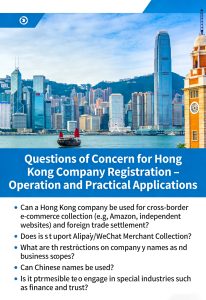
Can a Hong Kong company be used for cross-border e-commerce collection (e.g., Amazon, independent websites) and foreign trade settlement? Does it support Alipay/WeChat Merchant Collection? What are the restrictions on company names and busines...
View details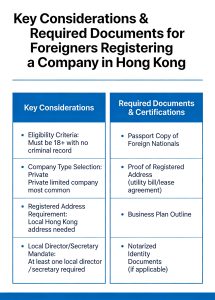
Address & Secretary: You must have a local physical address in Hong Kong (PO Boxes are not accepted). Additionally, you are required to appoint a local Hong Kong secretary (either a Hong Kong resident or a licensed secretarial company).
View details
When choosing a company name for registration in Hong Kong, you have the flexibility to use either English, Chinese, or both languages, but there are specific guidelines to follow: Language Consistency– You can register your company with eith...
View details